Pick what happened. The router gives the first move and the order to work in for six common quality situations, from a customer complaint to a drifting process. Each path opens its own page with the steps and the tools.
What happened?
Customer complaint
Start with
Log it with a number, then contain suspect stock before you investigate.
Your path
- Complaint log
- Containment
- Root cause
- PFMEA update
- Control Plan
- Work instruction
- LPA question
- Effectiveness check
Repeat defect
Start with
Pull the last fix and ask why it did not hold.
Your path
- Review the last fix
- Restate the problem
- Contain it
- 5-Why
- Fishbone
- Corrective action
- Lock it in
- Effectiveness check
Supplier problem
Start with
Inspect the lot before it moves, then contain it and put it in writing.
Your path
- Receive and inspect
- Contain it
- Decide and tell
- Ask for the fix
- Find the cause
- Prove the fix
- Update the record
- Audit the source
New part launch
Start with
Confirm the PPAP level and customer requirements on day one, then start the PFMEA before the Control Plan.
Your path
Open this pathProcess drifting
Start with
Contain what was made since the last good check, then rule out the gage before you blame the process.
Your path
Open this pathGo straight to a path: Customer complaint · Repeat defect · Supplier problem · Audit finding · New part launch · Process drifting
The paths are a starting order, not a substitute for your customer’s requirements or your own procedures.
Each step in the router is a link. It opens that step's chapter in the free Field Book for the path.
Not sure which path? Three questions
- Has it happened before? If yes, use the repeat defect path, whoever found it. Start by pulling the last fix.
- Is it a new part, or a change before production? If yes, use the new part launch path.
- Who found it? A customer: customer complaint. An auditor: audit finding. Receiving or your line, in material from a supplier: supplier problem. Your own checks or a control chart, before anything failed: process drifting.
When two paths apply
Real problems do not always fit one box. Start on the path that protects the customer first, then switch at the step shown. Keep one number for the whole trail, so the record from the first report to the proof stays connected.
| What happened | Start on | Then switch to |
|---|---|---|
| A customer complaint traced to a supplier's lot | Customer complaint: log it and contain stock at your site and the customer's | Supplier problem at Ask for the fix, so the supplier answers for their cause |
| A customer complaint you have had before | Repeat defect: review the last fix first | Stay on it. Use the new complaint number and link the old one |
| An audit finding about a defect that keeps coming back | Audit finding: restate it against the requirement and fix the instance | Repeat defect at Review the last fix, for the deeper cause |
| Parts from a drifting process reached the customer | Customer complaint: log it and contain everything made since the last good check | Process drifting at Gage R&R, to rule out the gage before you blame the process |
| A supplier part fails during a launch | Supplier problem: contain the lot and tell the supplier in writing | New part launch at the step you had reached |
The six paths side by side
| Path | Usually raised by | First move | You finish with | Free help |
|---|---|---|---|---|
| Customer complaint | The customer | Log it with a number, contain suspect stock | Proof the fix held, before you close | Containment checklist builder, 8D report checker |
| Repeat defect | The customer or your own line, again | Pull the last fix and ask why it did not hold | A fix that changes the process, proven with an effectiveness check | 5 Why helper, effectiveness check guide |
| Supplier problem | Receiving inspection or your line | Inspect the lot, contain it, put it in writing | A fix proven over several lots, on the part history and scorecard | SCAR guide, 8D report checker |
| Audit finding | An internal, customer or certification auditor | Restate it against the exact requirement | Objective evidence the fix is in place and working | Audit finding response builder |
| New part launch | A new part or a change | Confirm the PPAP level and customer requirements on day one | The PPAP submission at the level your customer requires | Launch readiness check, PFMEA to Control Plan check |
| Process drifting | Your own checks or control charts | Contain since the last good check, rule out the gage | An updated Control Plan and proof the fix held | Control chart guide, Cpk vs Ppk guide |
Ready-made help for each path
Every path has a free Field Book that follows one made-up case through all eight steps, and a printable Monday Board. If you want the files ready to fill in, the Excel workbooks for each path are on the Workbooks page.
| Path | Free Field Book | Free Monday Board | Excel workbooks |
|---|---|---|---|
| Customer complaint | Book 1: One Complaint | Board 1 | Complaint and repeat defect |
| Supplier problem | Book 2: One Bad Lot | Board 2 | Supplier problem |
| Process drifting | Book 3: One Drifting Shaft | Board 3 | Process drifting and measurement |
| New part launch | Book 4: One New Part | Board 4 | New part launch |
| Repeat defect | Book 5: One Comeback | Board 5 | Complaint and repeat defect |
| Audit finding | Book 6: One Finding | Board 6 | Audit finding |
Print the router
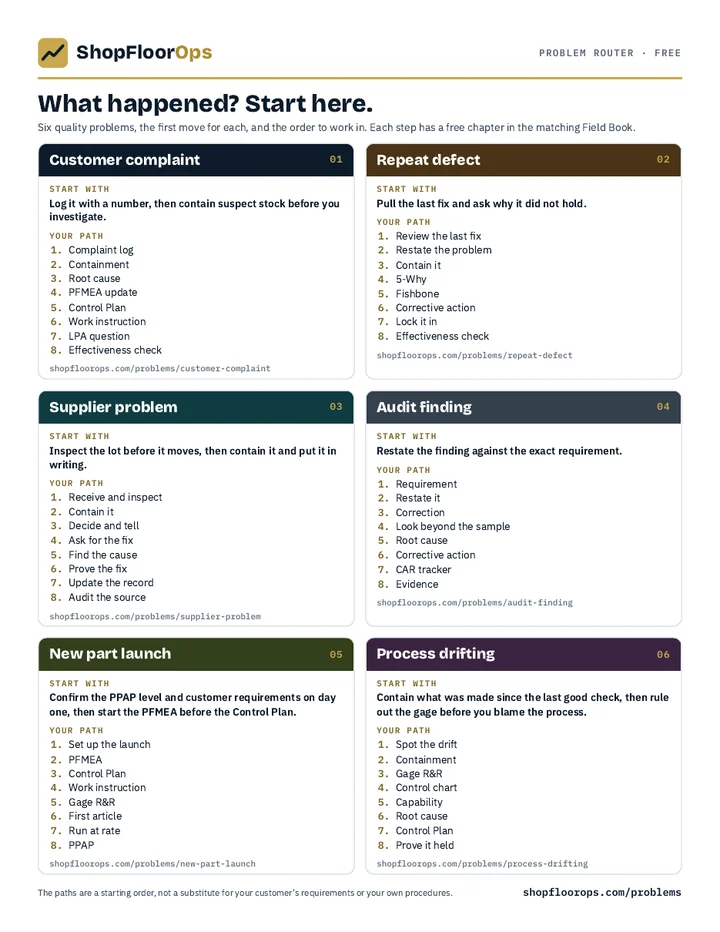
All six paths on one page, with the first move and the eight steps for each. It prints on a single Letter sheet. Pin it on the quality office wall, or hand it out at the start of a problem meeting. Free, no signup.
In ShopFloor Press
Recent editions where these problems showed up in the news.
- Customer complaint: One bad batch, 617 SUVs recalled (Vol. I No. 2). A recall over an incomplete production process.
- Repeat defect: Check the crimp, 39,052 engines recalled (Vol. I No. 5). A recall over crimped fuel filter hoses.
- Supplier problem: Their recall, your clock (Vol. I No. 7). Two recalls that began at a supplier.
- Audit finding: Torque you can’t prove (Vol. I No. 6). Two torque control recalls.
- New part launch: Which edition are you working to? (Vol. I No. 8). An automaker reverts its process FMEA and control plan approval rules.
- Process drifting: Capability Numbers on Request (Vol. I No. 10). An FDA letter asks a drug maker for process capability index calculations on every critical step.
Questions people ask
Do I need an 8D for every problem?
No. Every nonconformance gets recorded, but only the ones that matter, repeat or reach the customer need a full corrective action. Many automotive customers ask for an 8D, and IATF 16949 asks for a documented problem-solving process rather than an 8D by name. Check what your customer specifies.
When does a problem need a corrective action?
When it reached the customer, has happened before, affects safety, fit or function, came from an audit, or your procedure says so. Write the triggers down so the decision is not made case by case.
What is the difference between containment, correction and corrective action?
Containment protects the customer now by finding, isolating and sorting suspect product. A correction fixes the specific instance that was found, such as reworking the bad part. A corrective action removes the cause so it does not happen again.
What if two paths apply?
Start on the path that protects the customer first, then switch to the second path at the step that fits. The table above shows the common pairs. Keep one number for the whole trail.
When can I close it?
Only after the effectiveness check: proof from your own data that the fix worked and kept working. Decide what proof you will accept before the fix goes in, then check on schedule before closing.
Is retraining a corrective action?
Only rarely. If the cause was a missing or wrong instruction, fixing the instruction is the corrective action. Retraining alone assumes people will not make the same mistake again.
Do I send a SCAR for every supplier problem?
Follow your supplier quality procedure. Common triggers are any nonconformance that reached your production or your customer, repeat problems, and issues on safety or special characteristics. A single minor issue is often handled with a supplier notice instead.