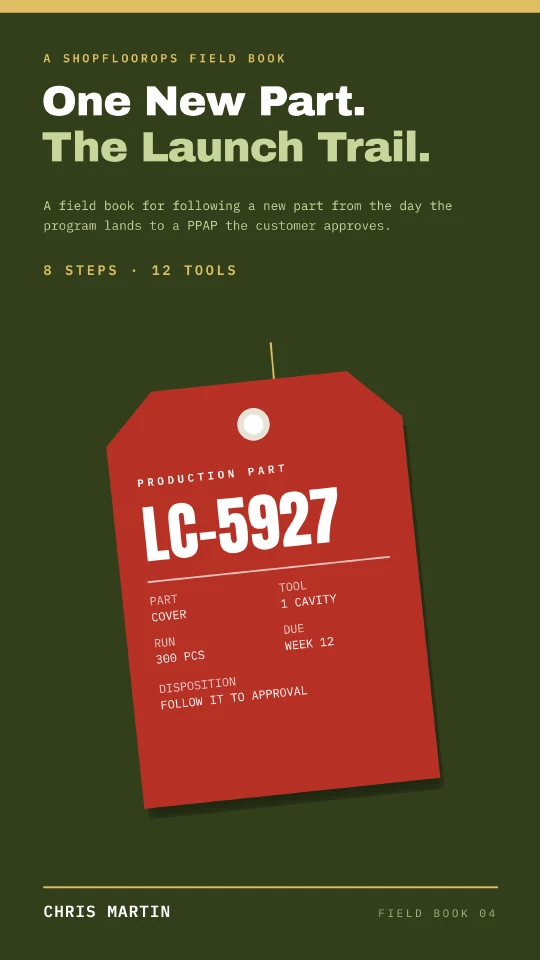
A new part launch runs through eight steps: set up the launch, write the PFMEA, build the control plan, train the station, prove the gage, make the first article, run at rate and submit the PPAP. This free field book, The Launch Trail, follows one made-up part, latch cover LC-5927, through all eight steps and 12 tools, one chapter per step, from the day the purchase order lands to an approval. PPAP is an automotive process and your customer’s requirements come first. The steps hold for any new part launch.
Prefer to read offline? The whole book is one short PDF. Short on time? The Monday Board is eight actions on one printable page.
The eight steps
- 01Set Up the LaunchRequirements and PPAP planDay one of a new part launch is for reading: the drawing, the special characteristics, the customer requirements and the PPAP level. Then plan backward from the due date.
- 02Write the PFMEAProcess FMEA and Action PriorityWrite the PFMEA before the control plan. Walk the process flow, rate severity, occurrence and detection, look up Action Priority, and re-rate only when the new controls are working.
- 03Build the Control PlanControl plan and reaction planEvery risk that needs action lands on a control plan row: what is checked, how, how often, by whom, and a reaction plan that says what to do, who to call and who can restart.
- 04Train the StationWork instruction and sign offA control plan only works if the operator can follow it. Write the work instruction for the station, release it at a revision, then watch each operator find a planted bad part before you sign them off.
- 05Prove the GageGage R&R and calibrationEvery number from the first article on comes from a gage. Run Gage R&R on the gages for key characteristics, fix a fixture that fails, and check calibration is in date.
- 06Make the First ArticleFirst article inspectionA first article is parts from the production process measured against every characteristic on the drawing. Record each reading, not just pass or fail, and tie the results to the setup.
- 07Run at RateInitial process studyA first article shows the tool can make good parts. A run at rate shows the process can keep making them. A worked 300 piece study, and what stopping at piece 150 would have hidden.
- 08Submit the PPAPPackage, warrant and approvalAssemble the package at the level the customer requires, make every record agree, sign the Part Submission Warrant and submit early. What to do if it comes back rejected.
Questions people ask
What is this field book?
It is a free book by Chris Martin that follows one made-up new part, latch cover LC-5927, through the eight steps of a launch. Each chapter covers one step and ends with what to do on the floor Monday.
What are the eight steps of a new part launch?
Set up the launch and plan backward from the due date, write the PFMEA, build the control plan from it, train the station, prove the gage, make the first article, run at rate to measure capability, and submit the PPAP.
Why write the PFMEA before the control plan?
The control plan’s rows should come from the PFMEA’s risks. Write the plan first and the PFMEA becomes paperwork that copies it, and the risks the plan missed stay missed.
Is this only for automotive PPAP?
PPAP is an automotive process, and your customer’s requirements come first. The steps hold for any new part launch, with or without a PPAP.
Do I need ShopFloorOps tools to use it?
No. Every chapter teaches the step itself, so you can use your own forms. The tool sidebars show ShopFloorOps tools, which I make and sell.
Is latch cover LC-5927 a real part?
No. The part, the tool, the program and every number are a made-up example used to show how the steps connect.
Start somewhere else
The part, the tool, the program and every number in this book (latch cover LC-5927) are a made-up example. The tool sidebars show ShopFloorOps tools, which I make and sell. Every chapter teaches the step itself, so you can use your own forms. New to a term? See the quality glossary.