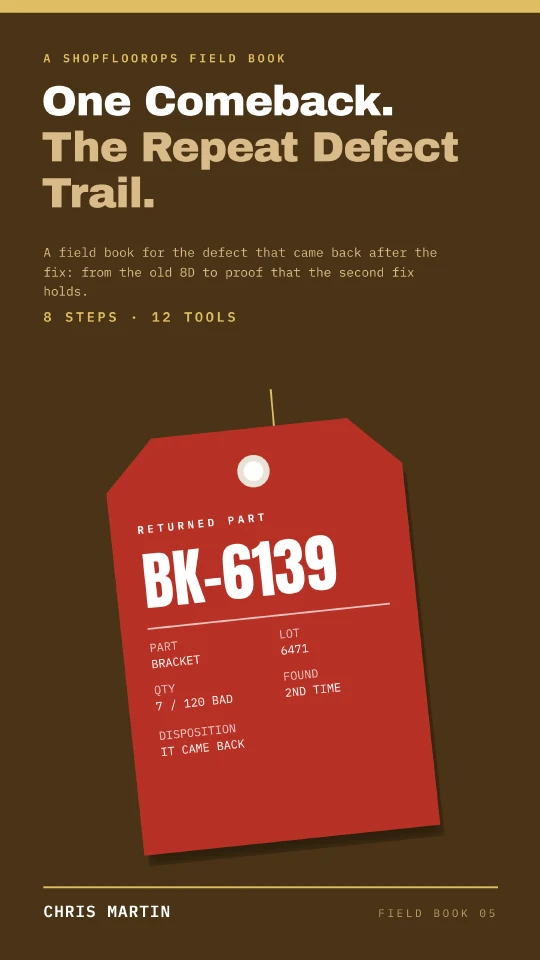
A repeat defect runs through eight steps: review the last fix, restate the problem, contain it, run the 5-Why, check the fishbone, choose the corrective action, lock it in and set the effectiveness check. This free field book follows one made-up bracket, sensor bracket BK-6139, whose hole spacing defect came back 11 weeks after an 8D closed, through all eight steps and 12 tools, one chapter per step. The old 8D is evidence, not the answer.
Prefer to read offline? The whole book is one short PDF. Short on time? The Monday Board is eight actions on one printable page.
The eight steps
- 01Review the Last FixThe old 8D is evidenceWhen a defect comes back, pull the old 8D before anyone walks the floor. Was the cause proven or only stated, and did the action change the process or the person?
- 02Restate the ProblemBoth occurrences side by sideWrite the problem statement again from the evidence: the same facts for both occurrences, then what changed. Is it one problem that came back or two that look alike?
- 03Contain ItTreat what is made as suspectThe defect is back, so check the same four places again: the customer, in transit, finished goods and work in process. Sort every piece with a gage that reads the characteristic.
- 045-WhyOccurrence, escape and systemA repeat defect needs three chains: why it happened, why it was not caught and why the system let the first answer close. Prove the cause by turning it on and off.
- 05FishboneThe categories skipped last timeThe fishbone checks that you did not stop looking too soon. Mark every cause confirmed, ruled out or unknown, with evidence, and test each against both occurrences.
- 06Corrective ActionChange the process, not the personRank actions from removing the possibility to training, match one to each proven cause, and give every action an owner and a date. Training alone is never enough.
- 07Lock It InPFMEA, control plan, instruction, auditFour records have to change together after a repeat defect: the PFMEA, the control plan, the work instruction and the layered process audit. Then check they all agree.
- 08Effectiveness CheckSet the proof before the fix goes inWrite an effectiveness check that can fail: a window long enough to include the failure cycle, a pass line, an owner and a review date. Close the action on evidence.
Questions people ask
What is this field book?
It is a free book by Chris Martin that follows one made-up defect, a sensor bracket with hole spacing over the limit, through the eight steps of a repeat. Each chapter covers one step and ends with what to do on the floor Monday.
What are the eight steps when a defect comes back?
Review the last fix, restate the problem with both occurrences side by side, contain it, run the 5-Why on occurrence, escape and system, check the fishbone, choose a corrective action, lock it in across the PFMEA, control plan, work instruction and audit, and set the effectiveness check.
Why is the old 8D evidence and not the answer?
The old report records what the team believed at the time. Most repeats show the same pattern: the cause was stated but never proven, the fix depended on people remembering, and the check was too short to see the failure return. Read it, mark what was proven, and do not start from its cause.
How is this different from the Complaint-to-Closure Trail?
The Complaint-to-Closure Trail follows one complaint from the first email to a proven fix. This book is the second time around, for a defect that came back after a fix was closed. It keeps the steps that matter on a repeat and links to the first book for the basics.
Do I need ShopFloorOps tools to use it?
No. Every chapter teaches the step itself, so you can use your own forms. The tool sidebars show ShopFloorOps tools, which I make and sell.
Is sensor bracket BK-6139 a real part?
No. The part, the die, the lots and every number are a made-up example used to show how the steps connect.
Start somewhere else
The part, the die, the lots and every number in this book (sensor bracket BK-6139) are a made-up example. The tool sidebars show ShopFloorOps tools, which I make and sell. Every chapter teaches the step itself, so you can use your own forms. New to a term? See the quality glossary.