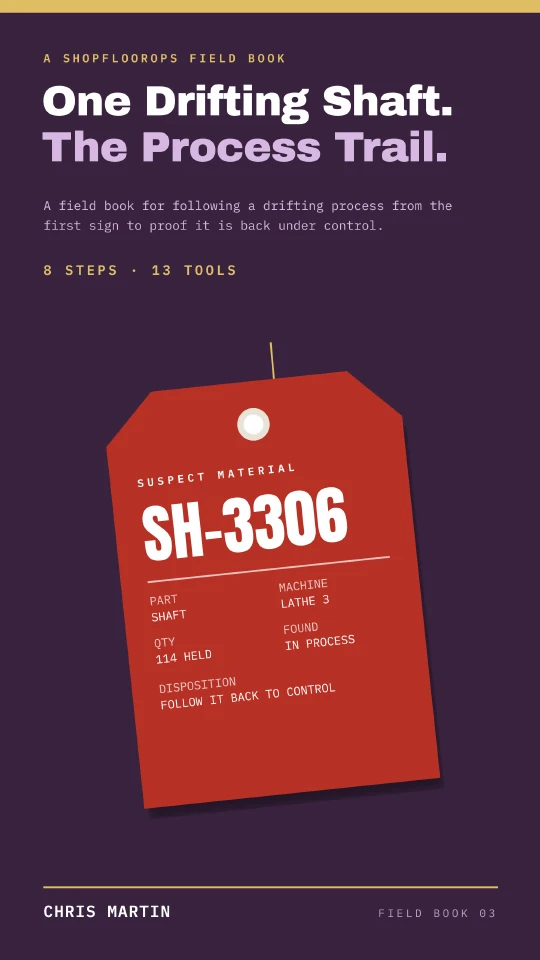
A drifting process runs through eight steps: spot the drift, contain it, rule out the gage, read the chart, measure capability, find what changed, lock it in and prove it held. This free field book, The Process Trail, follows one made-up case, shaft SH-3306 on Lathe 3, through all eight steps and 13 tools, one chapter per step, so you can trace a drift from the first reading to proof it is back under control.
Prefer to read offline? The whole book is one short PDF. Short on time? The Monday Board is eight actions on one printable page.
The eight steps
- 01Spot the DriftRead the check sheetEvery reading can pass while the process drifts. What to look for on an in-process check sheet, and the written call rule that stops the machine while parts are still good.
- 02Contain ItRed tag and quality alertEverything made since the last good check is suspect. How to count the window, find every piece, red tag it and send the quality alert before you sort.
- 03Rule Out the GageGage and calibrationBefore anyone touches a drifting process, prove the gage can tell good from bad: calibration, a check on a known size, and a Gage R&R against the tolerance.
- 04Read the ChartThe X-bar and R chartPlot the data in production order, set control limits from a stable stretch, and read the signals: a point beyond the limit and a run of eight. A worked X-bar and R example.
- 05Measure CapabilityCp and CpkCp compares the tolerance to the spread, Cpk adds where the center sits. A worked before and after on a drifting shaft, and how the gap between them tells you where to look.
- 06Find What ChangedCause on three legsCheck the usual five changes against the records and the time the chart says the change began, then run the cause on three legs: why it drifted, why it was not caught, why the system allowed it.
- 07Lock It InControl plan and reaction planWrite the control plan row that catches drift early: chart limits, an early warning input, the signals, and a reaction plan with a trigger, owners and the authority to stop.
- 08Prove It HeldCapability, effectiveness and LPAOne good shift is not proof. Set the criteria before you look, re-run capability, hold a 30 day window, and add a layered process audit question that keeps the fix in place.
Questions people ask
What is this field book?
It is a free book by Chris Martin that follows one made-up drifting process, shaft SH-3306 on Lathe 3, through the eight steps a real drift goes through. Each chapter covers one step and ends with what to do on the floor Monday.
What are the eight steps when a process drifts?
Spot the drift on the check sheet, contain everything made since the last good check, rule out the gage, read the control chart, measure capability, find what changed, lock it in with a control plan row and reaction plan, and prove the fix held.
Why rule out the gage first?
If the gage reads wrong, you will adjust a good machine to match a wrong number. Calibration, a check on a known size and a Gage R&R come before anyone touches the process.
Do I need ShopFloorOps tools to use it?
No. Every chapter teaches the step itself, so you can use your own forms. The tool sidebars show ShopFloorOps tools, which I make and sell.
Is the field book free?
Yes. Every chapter is free to read here with no signup, and the Monday Board is a free printable page.
Is shaft SH-3306 a real part?
No. The part, the machine, the shift and every number are a made-up example used to show how the steps connect.
Start somewhere else
The part, the machine, the shift and every number in this book (shaft SH-3306 on Lathe 3) are a made-up example. The tool sidebars show ShopFloorOps tools, which I make and sell. Every chapter teaches the step itself, so you can use your own forms. New to a term? See the quality glossary.