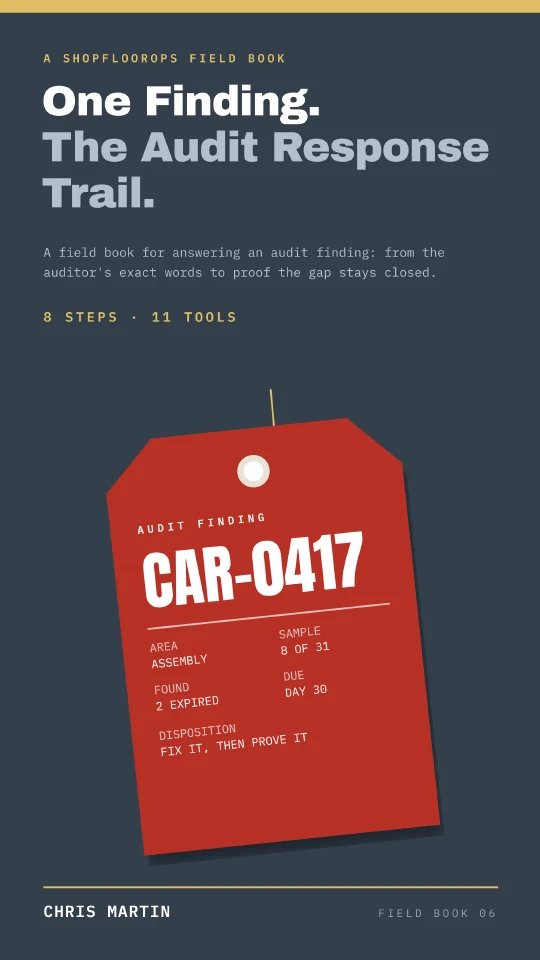
Answering an audit finding runs through eight steps: copy the requirement, restate the finding, make the correction, look beyond the sample, find the root cause, choose the corrective action, set up the CAR tracker and gather the evidence. This free field book follows one made-up customer audit finding, expired gasket adhesive found in use, through all eight steps and 11 tools, one chapter per step. Follow the requirement your auditor or customer cites.
Prefer to read offline? The whole book is one short PDF. Short on time? The Monday Board is eight actions on one printable page.
The eight steps
- 01RequirementAnswer the question askedEvery response answers two things: the requirement the auditor says was not met and the evidence they recorded. Copy both exactly, then check which question the requirement asks.
- 02Restate ItAgree the problem before you digWrite the finding as a problem statement with the what, where, how many and requirement, and no cause. One email to the auditor settles what the response has to cover.
- 03CorrectionFix the instance found, nothing moreA correction deals with the specific instance the auditor wrote down: remove the material, find the product made with it, say where it is and test what you can. Keep it apart from the corrective action.
- 04Look Beyond the SampleCheck what the auditor did not pullThe finding describes the sample, but your response has to describe the plant. Define the population, check all of it, count, and write down what you looked at and what you found.
- 05Root CauseEnd at a process, not a personAn audit finding is a system failure found in a sample. Ask why until the chain ends at a process, a responsibility or a check that was missing, and not at a person.
- 06Corrective ActionChange the system, not the personTraining and reminders fade. Put an action against each cause that changes the procedure, the form, the schedule or the check, with an owner and a due day.
- 07CAR TrackerOwner, dates and statusA response is a promise and the tracker is where it gets checked every week. Give each action one owner, a calendar date, a status and a pointer to the evidence.
- 08EvidenceRecords that already existEvidence is records made after the change that show it is in place and working. A plan to review records at the next audit is not evidence. Add one audit question to keep the gap closed.
Questions people ask
What is this field book?
It is a free book by Chris Martin that follows one made-up audit finding, gasket adhesive found in use past its expiry date, through the eight steps of a response. Each chapter covers one step and ends with what to do on the floor Monday.
What are the eight steps of an audit finding response?
Copy the requirement and the evidence, restate the finding as a problem statement, make the correction, look beyond the sample, find the root cause, choose a corrective action that changes the system, track it with owners and dates, and gather the evidence that it is in place and working.
Why do audit responses get sent back?
Four reasons run through the book: the response answers a different question than the finding asked, it stops at a person or at training, it offers a plan where a record is needed, or it fixes the sample but not the system.
Does the book rely on a particular standard?
No. It names no standard and quotes none. Follow the requirement your auditor or customer cites, in their own words.
Do I need ShopFloorOps tools to use it?
No. Every chapter teaches the step itself, so you can use your own forms. The tool sidebars show ShopFloorOps tools, which I make and sell.
Is the audit finding in the book real?
No. The plant, the finding, the stations and every number are a made-up example used to show how the steps connect.
Start somewhere else
The plant, the audit, the finding and every number in this book (finding CAR-0417) are a made-up example. The tool sidebars show ShopFloorOps tools, which I make and sell. Every chapter teaches the step itself, so you can use your own forms. New to a term? See the quality glossary.